Best Friends, Worst Teammates: The Weird Truth About Gaming With People You Actually Know
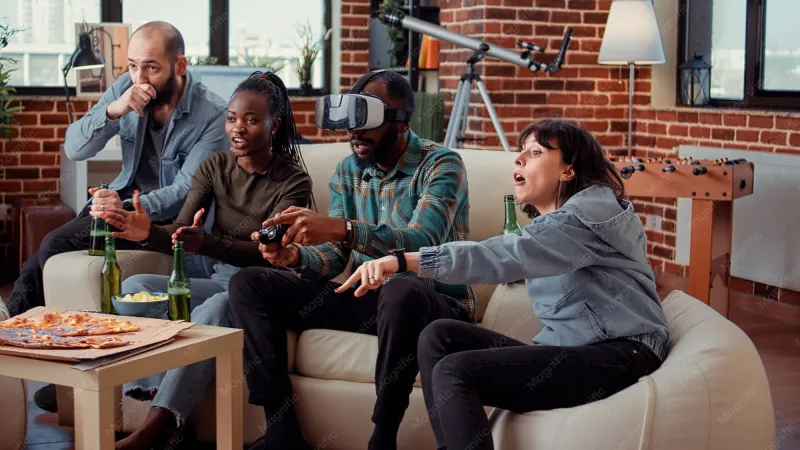
Photo: friends gaming together on couch looking frustrated or tense, via img.freepik.com
You've been hyping this up all week. Group chat is popping. Everyone's finally free on Saturday night. You fire up the game, hop into a lobby together, and within twenty minutes someone's gone quiet, someone else is backseat gaming, and the whole vibe has shifted into something that feels weirdly... tense. Nobody says it out loud, but you all feel it.
Gaming with your best friends is supposed to be the dream. And yet, more often than not, it quietly becomes the most complicated session of your week.
This isn't a you problem. It's not even a them problem. It's a psychology problem — and once you understand what's actually happening, the whole thing starts to make a lot more sense.
The Expectation Trap
When you sit down to game with people you genuinely love, you bring a lot more than a controller to the table. You bring history. You bring the memory of every inside joke, every rough patch, every time you've had to navigate each other's moods. That emotional context doesn't disappear when you load into a lobby — it follows you in.
The problem is that real-life friendships carry invisible contracts. There's an unspoken pressure to have fun on schedule, to match each other's energy, to perform enjoyment even when the game isn't landing. When you're playing with a stranger online, none of that baggage exists. You're just two people trying to win. The relationship is clean.
With your best friend? Every death, every missed callout, every moment of frustration gets filtered through years of relationship dynamics. It's not just a bad round — it's a moment loaded with context that neither of you signed up to deal with tonight.
Skill Gaps Hit Different When It's Personal
Here's something nobody wants to admit: playing with a friend who's significantly better or worse than you is genuinely awkward, and it gets more awkward the closer you are.
With a random online teammate, a skill gap is just data. You adapt, you compensate, you move on. With your best friend, that same gap carries emotional weight. The better player starts pulling punches to avoid making the other feel bad. The less experienced player starts apologizing for mistakes they'd brush off with a stranger. Both of you are now managing feelings instead of playing the game.
This is the collaboration paradox in action. The closer the relationship, the more emotional labor gets smuggled into the session. And emotional labor is exhausting — especially when all you wanted was to unwind.
Why Strangers Sometimes Become Your Best Squadmates
Ask any serious gamer about their most memorable online moments and there's a decent chance the story involves someone they met randomly in a lobby, not someone from their contact list. That's not a coincidence.
Strangers online offer something rare: zero expectations and zero history. When you're matched with someone you've never met, the only thing that matters is what happens in the game. There's no social maintenance required. You don't have to worry about their feelings outside of the match. You're just two people with a shared objective, and that clarity is genuinely freeing.
Research in social psychology backs this up. Bonds formed under shared challenge — even brief ones — can feel surprisingly deep. It's the same reason people who survive something difficult together often feel closer than lifelong friends who haven't been tested. A tough raid, a clutch comeback, a chaotic battle royale final circle — these moments create real connection, even between strangers.
The Scheduling Problem Is Real
There's also something worth naming about the forced nature of gaming with friends in real life. You didn't organically drift into this session — you planned it. You coordinated calendars, someone drove somewhere, maybe you ordered food. The whole thing has the energy of an event now, and events carry pressure.
Fun doesn't work well under pressure. Creativity doesn't either. Some of the best gaming moments happen when you're alone at midnight, or when you randomly hop online and end up in a squad with strangers who happen to be exactly your vibe. Those moments can't be scheduled. But your Saturday night gaming hangout absolutely was.
That manufactured quality changes the whole texture of the experience before anyone even picks up a controller.
Navigating the Tension Without Torching the Friendship
None of this means you should stop gaming with your friends. It just means you need to be smarter about how you do it.
Pick the right game for the relationship. Competitive games amplify tension. If you've got a crew with mixed skill levels or strong personalities, lean into co-op games with low stakes — something where you're all working against the game itself rather than each other. Overcooked, It Takes Two, Minecraft — these formats invite collaboration without turning skill gaps into flashpoints.
Give people an out. One of the biggest mood killers in group gaming is the feeling of being trapped. Make it explicitly okay for someone to tap out early, switch games, or just watch. When nobody feels obligated to perform enjoyment, the real thing has room to show up.
Stop trying to recreate a feeling. A lot of gaming hangouts are secretly attempts to bottle an experience you had five years ago — a specific energy from a specific era of your friendship. That's a losing game. Let this session be its own thing. Lower the nostalgic stakes and you lower the pressure.
Talk about it, even briefly. It sounds almost too simple, but a quick "hey, I'm kind of bad at this one, just warning you" before a session does a surprising amount of work. It defuses the expectation, gives everyone permission to be imperfect, and reframes the whole vibe from performance to play.
The Real Utopia Is Knowing Which World to Play In
Here at Yu-Topia, we're always chasing the version of things that actually works — not just the version that sounds good in theory. And in theory, gaming with your best friends is the ultimate experience. In practice, it's complicated, human, and sometimes kind of a mess.
The good news is that both things can be true. Some of your deepest gaming memories will come from strangers you'll never meet again. Some will come from people who know your whole life story. The trick is knowing which context calls for which kind of connection — and not forcing the magic when the conditions aren't right.
Your best friend might be your worst teammate. Your best teammate might be a username you'll forget by Tuesday. Both of those people can make gaming feel like exactly the escape it's supposed to be. You just have to stop expecting them to be the same person.